On this page
- ›What is serverless computing?
- ›Serverless computing trends
- ›Serverless computing use cases in 2026
- ›Key benefits of serverless computing in 2026
- ›Why is serverless computing called Function-as-a-Service (FaaS)?
- ›Best serverless platforms in 2026 (and when serverless costs more)
- ›Summing up
- ›Frequently asked questions
Serverless computing allows businesses to build agile and scalable applications while saving costs.
As it gains rapid traction, it is no wonder that it develops and expands, offering new features to expect in the near future. As serverless becomes a foundation of cloud application development, new architectures are shaping how apps scale and evolve.
The short version:
Five shifts define the serverless computing trends 2026:
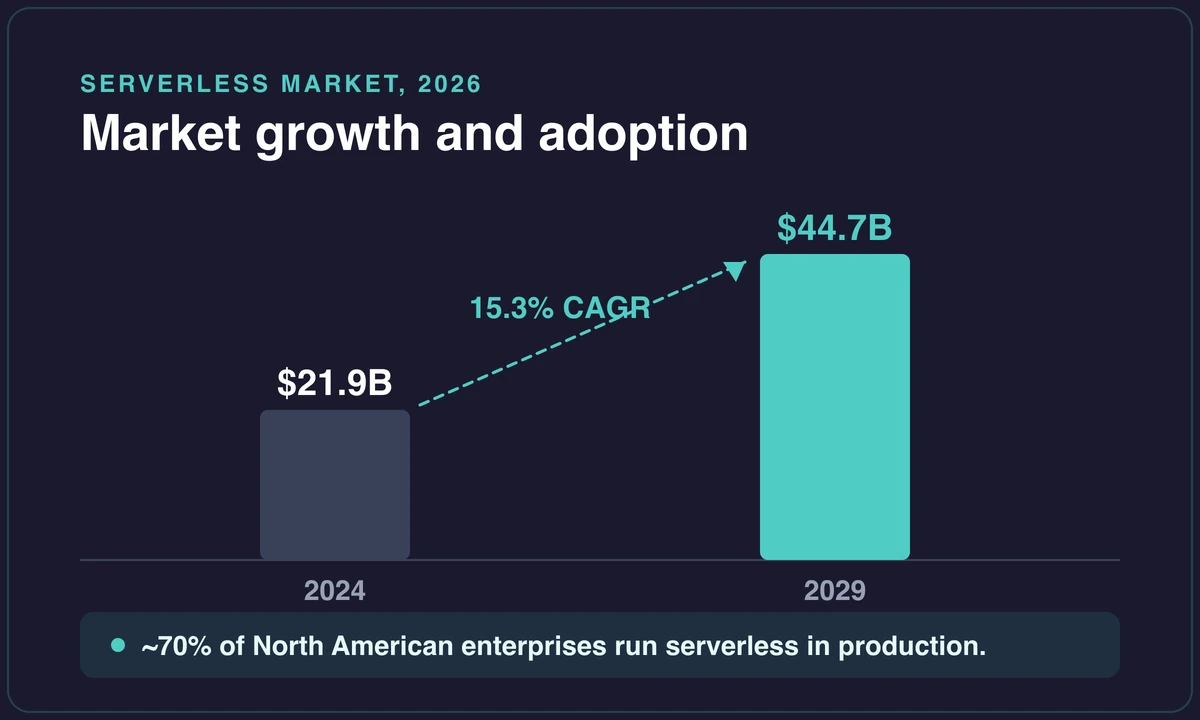
- Market growth. The market is on track to reach USD 44.7 billion by 2029 at a 15.3% CAGR.
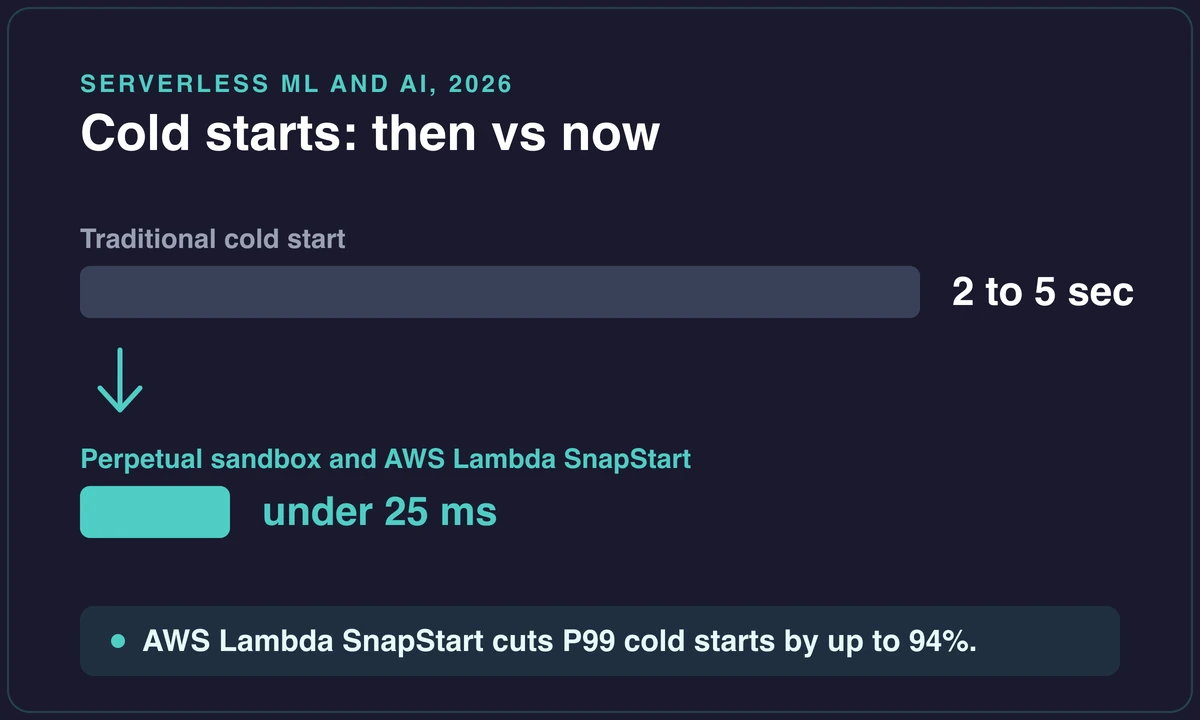
- Faster cold starts. AI-agent workloads now resume in under 25ms, against the 2-5 seconds a cold start used to cost.
- Hybrid by default. Roughly 78% of teams now mix serverless with containers.
- Wasm at the edge. WebAssembly modules start in 1-5ms and run across thousands of edge locations.
- The cost caveat. Serverless is cheaper for bursty work, but steady high load can flip costlier than containers.
What is serverless computing?
In short, serverless computing is a model where a provider (AWS, Google Cloud, Azure) automatically gives your code the servers it needs and tears them down when it finishes. You pay only for the runtime your code uses, not for an always-on server. That is what makes it cheaper for bursty work. Here is where the field is heading.
Serverless computing trends
Here are the serverless computing trends 2026 is being shaped by, from market growth to the platforms doing the work:
| # | Trend | What is changing in 2026 |
|---|---|---|
| 1 | Broader adoption | Market heading to USD 44.7B by 2029 (15.3% CAGR); close to 70% of North American enterprises run serverless in production |
| 2 | ML and AI | Cold starts drop to under 25ms; AWS Lambda SnapStart (GA) trims P99 cold starts up to 94% |
| 3 | Multi-cloud and hybrid | Functions move across clouds and on-prem with Knative and OpenFaaS |
| 4 | Edge computing | WebAssembly at the edge starts in 1-5ms; Cloudflare Workers span 300-330+ locations |
| 5 | Complex workloads | Hybrid is the default: about 78% of teams mix serverless and containers |
Trend #1. Broader adoption of serverless computing
Broader adoption is the headline. Scalability, cost reduction, and agility keep pulling new teams in.
The market sat at about USD 21.9 billion in 2024. It is on track to reach USD 44.7 billion by 2029 at a 15.3% compound annual growth rate. Adoption backs that up. Close to 70% of North American enterprises now run production workloads on serverless. Around 65% are adopting or planning to adopt it within 18 months.
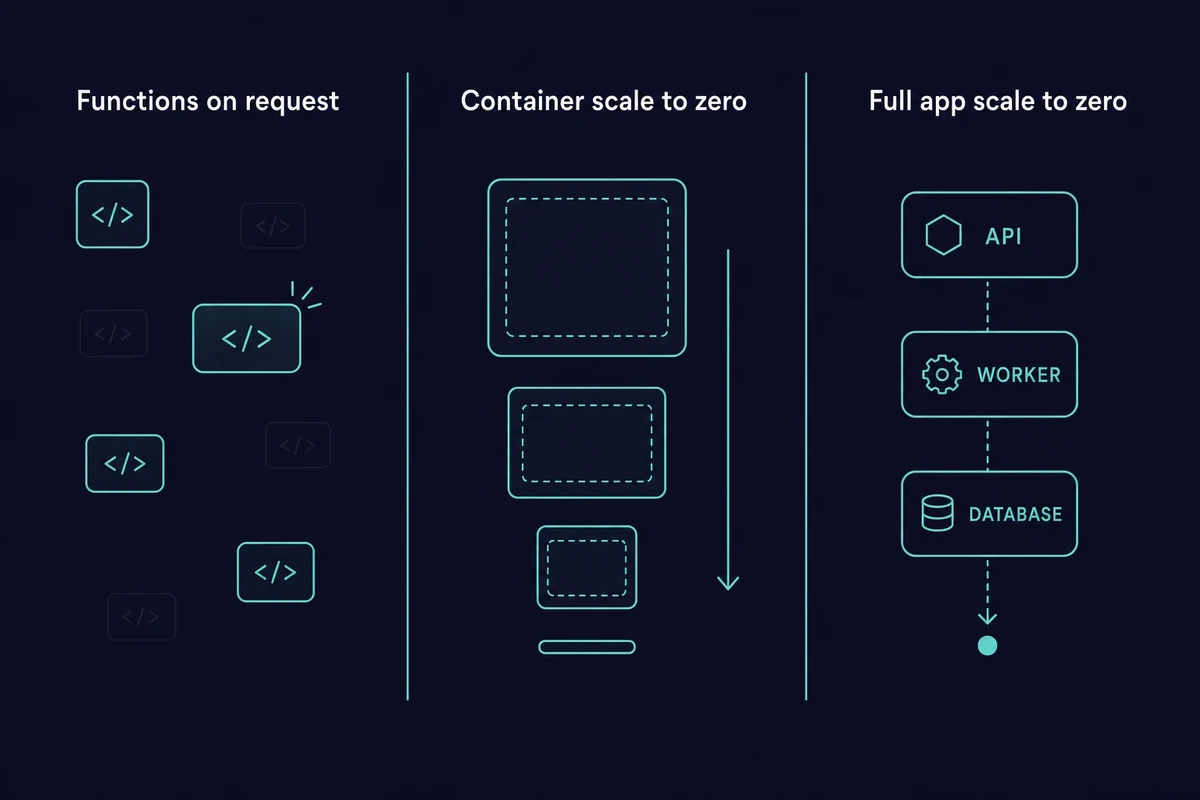
Statefulness is the other shift. Serverless used to be mainly for stateless apps that did not hold their state across runs. Now the move to stateful “Serverless 2.0” is in full swing. Full-stack apps scale to zero and copy state to the nearest edge node. Both AWS and Microsoft Azure ship products that let apps hold state while running many functions.
Trend # 2. Gaining more ground with ML and AI
ML and AI are the second pull. Serverless cuts the cold-start tax that used to make ML inference painful, which matters more every year given upcoming ML/AI challenges.
The cost picture is stark. Deloitte’s 2025 report says power-hungry ML and AI products will consume 4% of all electricity used by humanity in 2030. An IBM report adds that the cost of AI computing has climbed 89% between 2023 and 2025. Some executives have postponed or canceled AI work because of it, especially in generative AI.
Cold starts are the fix. Serverless runs on-demand and bills pay-as-you-go, so it gives ML and AI work cheaper servers that flex with demand.
Perpetual-sandbox platforms now resume AI-agent workloads in under 25ms. That is against the 2-5 seconds a typical cold start used to cost. AWS Lambda SnapStart, now generally available for Python and .NET in 2026, cuts P99 cold starts by up to 94%.
On the hardware side, even Macs handle ML workloads well. Machine learning on Mac has become more viable thanks to Apple Silicon chips. Serverless suits models that users trigger on demand, like voice recognition or image processing. It also works well as a backend for apps running LLM models locally, or for voice bots and chat boxes.
Trend # 3. Extension to multi-cloud and hybrid environments
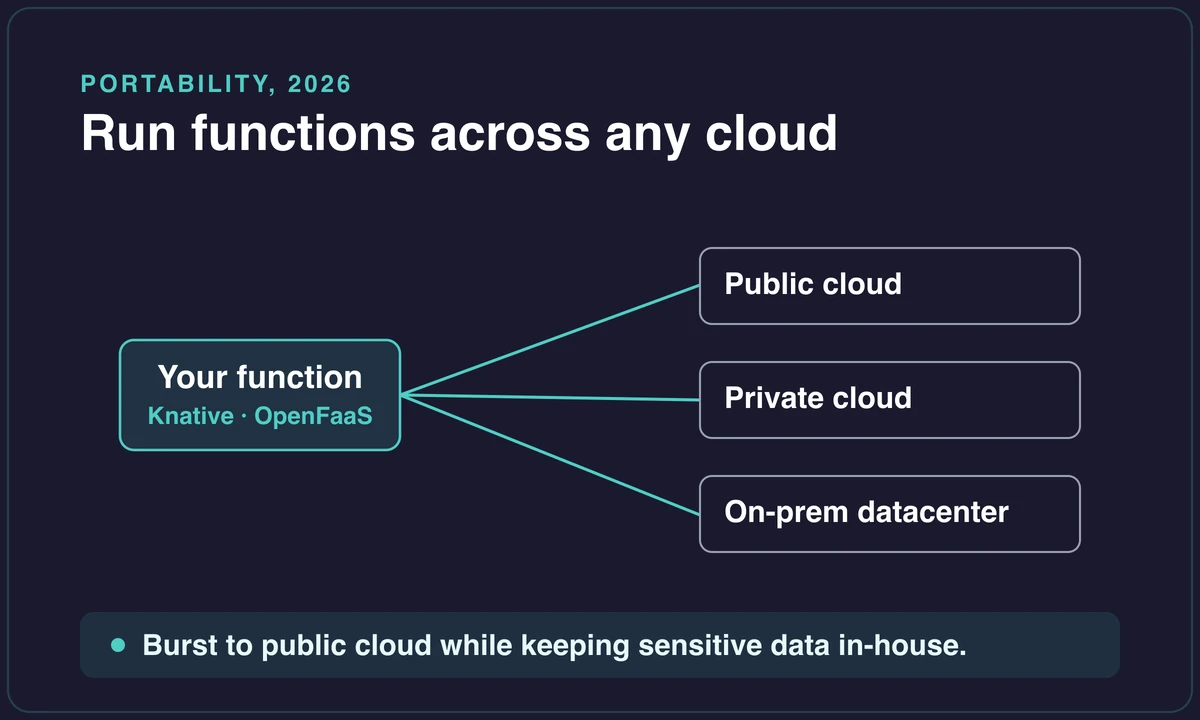
Multi-cloud and hybrid are gaining ground. New services let users move and run functions across different cloud and on-premise environments. Products like Knative and OpenFaaS lead here.
This helps businesses that run part of their operations on public clouds and keep sensitive data in-house.
Trend # 4. Integration with edge computing
Edge computing is the fourth shift. Major providers like AWS already integrate serverless and edge products. For Amazon, that means AWS Lambda@Edge and Azure IoT Edge.
Serverless lets certain apps run closer to the end user. That decreases latency for IoT devices, gaming, and real-time analytics.
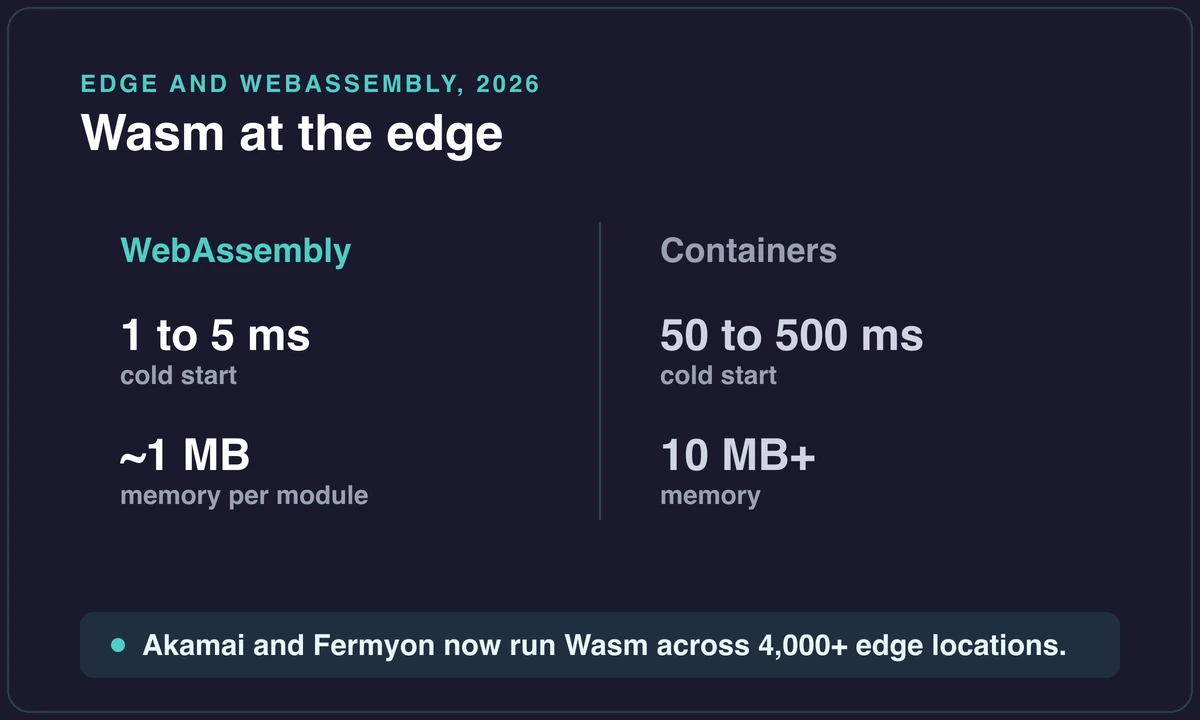
WebAssembly is the 2026 story here. Wasm modules start in 1-5ms, against 50-500ms for containers, and use about 1MB of memory. So providers are pushing them to the network edge. Akamai acquired Fermyon to run Wasm serverless across 4,000+ edge locations. Cloudflare Workers now span 300-330+ locations with sub-millisecond cold starts.
Higher traffic loads are coming too. The number of IoT devices will double by 2030, reaching 40 billion. That puts real strain on cloud servers.
Trend # 5. Managing complex workloads
Complex workloads round out the five. Serverless services are moving from plain function execution to heavier, resource-intensive tasks.
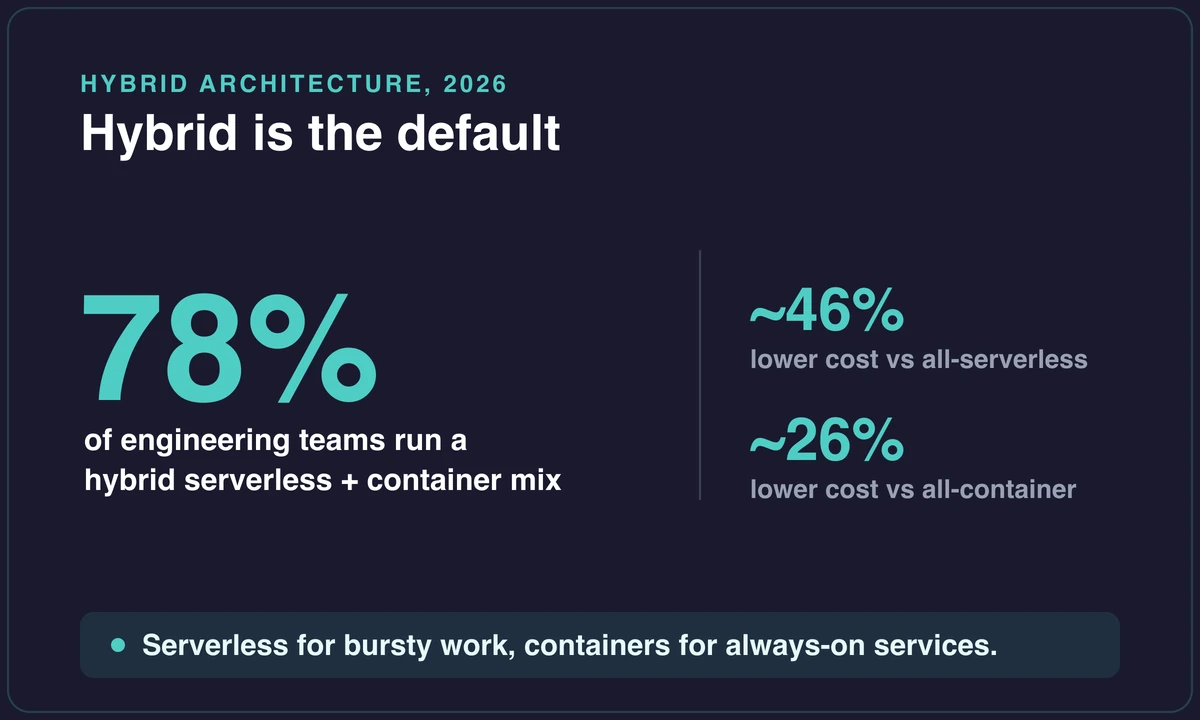
Hybrid is now the default. Roughly 78% of engineering teams run a mix of serverless and containers. They use serverless for bursty event-driven work and containers for always-on services. That split saves about 46% versus all-serverless and about 26% versus all-container. Container integrations like AWS Fargate are central to it.
Serverless is expected to ease the limits of more complex tasks too, like memory and concurrency caps and execution-duration ceilings.
Serverless computing use cases in 2026
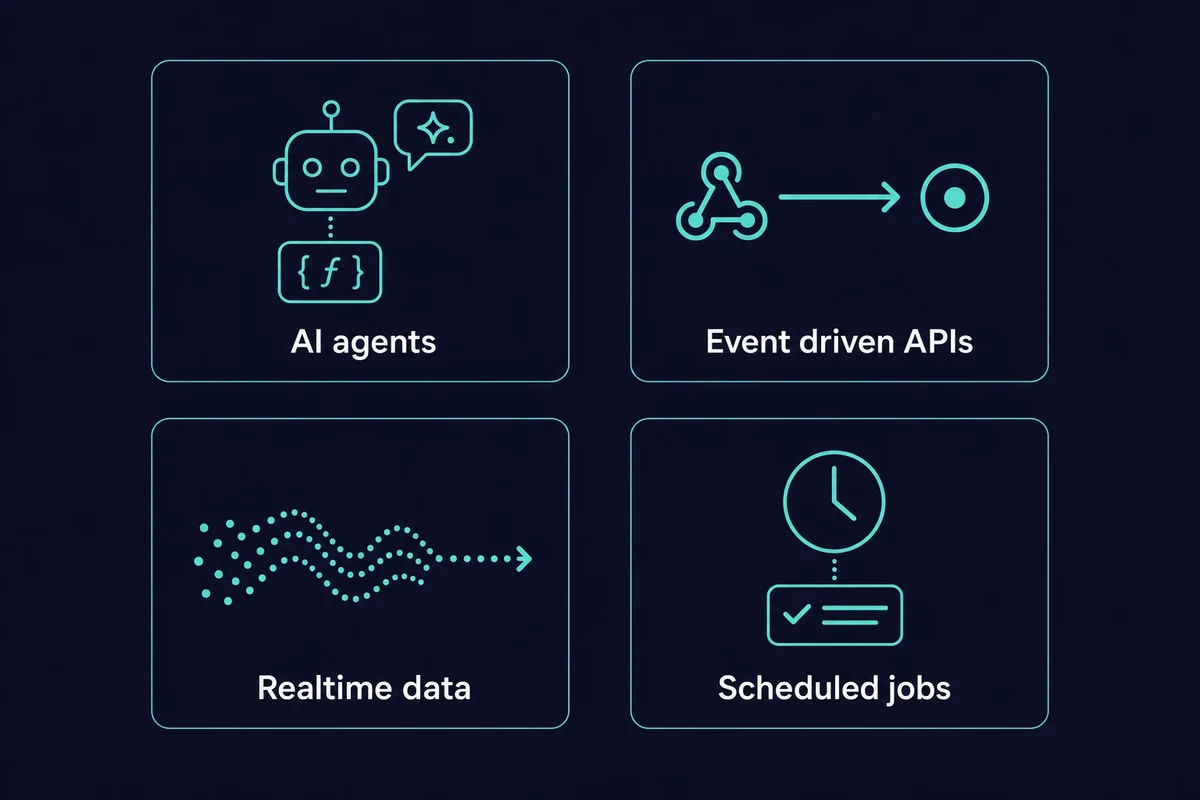
In 2026 the heaviest serverless computing use cases cluster around four jobs. These serverless computing use cases all share one trait: bursty, unpredictable load that would waste money on an always-on server.
- AI agents. Perpetual-sandbox platforms resume in under 25ms, against the 2-5 seconds a cold start used to cost. That makes serverless a fit for code review, testing automation, and production RAG pipelines.
- Event-driven APIs and webhooks. Functions scale to zero between requests, and you pay per invocation. A quiet endpoint costs nothing.
- Real-time data and stream processing. Process IoT and analytics events close to the source. This ties back to the edge trend above.
- Scheduled background jobs. Image processing, voice recognition, and nightly batch run on a timer, with no server idling in between.
If you prototype on your own hardware first, machine learning on Mac and running an LLM locally both pair well with this pattern before you push the model to a cloud function.
One honest line before you go all-in. Serverless suits bursty, spiky work. Steady, high-throughput work is usually cheaper on containers. The platforms section below covers when the bill flips.
Key benefits of serverless computing in 2026
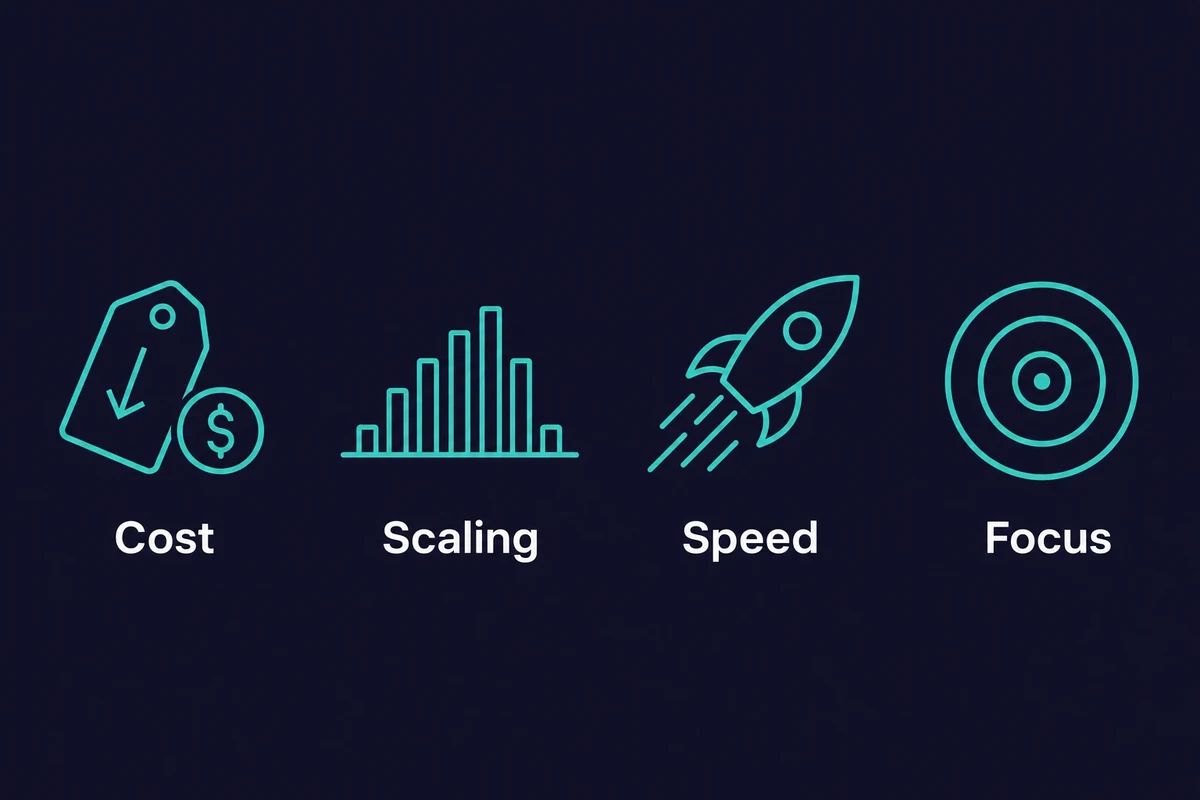
The key benefits of serverless computing are concrete. No servers to set up, automatic scaling, and a bill that drops to zero when nothing runs. Companies that adopt it report 60-70% lower server costs and up to 70% faster deployments. Those numbers assume bursty, event-driven workloads, not steady load.
- Cost. You pay only for the runtime your code uses, which is where the 60-70% savings come from. The caveat is steady load: a constantly busy service can flip costlier than containers.
- Scaling. There is zero manual setup. The platform adds capacity when traffic spikes and scales to zero when it stops.
- Speed. Teams report up to 70% faster deployments, because there is less to stand up.
- Focus. Engineers ship features instead of managing capacity. That is often the real reason a team moves.
Why is serverless computing called Function-as-a-Service (FaaS)?
Serverless follows the Function-as-a-Service model. It executes code in the form of functions. They run separately, and you pay only for the time a function is computed.
The model grew out of microservices. Older products were built as one linked code bundle. Microservices split each feature into a separate piece shipped on its own. Serverless took that further by giving each function its own servers. A server runs when a microservice runs, and you pay for that time only.

Best serverless platforms in 2026 (and when serverless costs more)
There is no single best serverless platform; the right one depends on your runtime and traffic shape. AWS Lambda leads for breadth, Cloudflare Workers for global low-latency edge, Google Cloud Run and AWS Fargate for container work, and Vercel and Azure Functions for app-framework and Microsoft-stack teams.
| Platform | Best for | Limits | Free tier or entry price |
|---|---|---|---|
| AWS Lambda | Breadth and AWS integrations | Up to 10GB memory, 15-min max execution | 1M requests/mo + 400k GB-seconds free |
| Cloudflare Workers | Global low-latency edge | 128MB memory, 30s CPU per request, 300-330+ locations | 100k requests/day free, then $5/mo for 10M |
| Google Cloud Run | Container workloads, steady load | Container-based, longer-running tasks | Per-vCPU/second billing, generous free tier |
| AWS Fargate | Always-on container services | No 15-min cap, sized per task | Pay per vCPU and memory provisioned |
| Azure Functions | Microsoft-stack teams | Consumption or premium plans | 1M executions/mo free on consumption |
| Vercel | Front-end and app-framework teams | Edge and serverless functions | Free hobby tier, then per-seat plans |
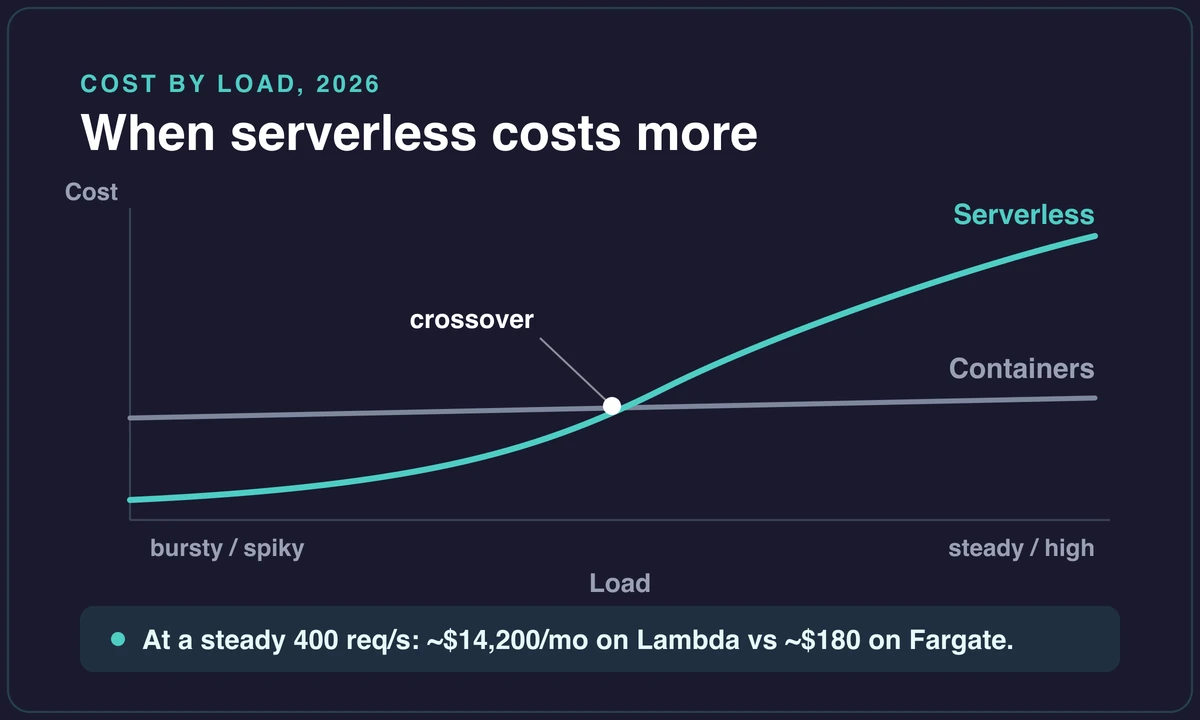
Now the honest part: serverless flips costlier at steady load. One Series-A startup running 400 requests per second paid about USD 14,200 per month on Lambda. The equivalent on Fargate ran roughly USD 180 per month.
Since August 2025 AWS also bills the cold-start INIT phase. Hidden line items like NAT Gateway at $0.045/GB and CloudWatch Logs add up too. The rule of thumb: functions for spiky traffic, containers once load is constant.
Summing up
The core idea is simple. The provider gives your code the servers it needs as parts start running. After the function runs, the server stops. So you pay only for the time the tasks run. That is what drives the agility and cost savings, while a microservices setup makes apps easier to scale and update.
If you are weighing the work without a Mac of your own, you can still develop iOS apps and run server-based tasks by accessing one remotely.
Frequently asked questions
What are the main serverless computing use cases in 2026?
The heaviest 2026 use cases are AI-agent workflows (PR review, testing, RAG), event-driven APIs and webhooks, real-time data and stream processing, and scheduled background jobs. They share bursty, unpredictable load that would waste money on an always-on server.
Is serverless computing always cheaper than containers?
No. Serverless wins for bursty, event-driven work but flips costlier at steady high load. One Series-A startup at 400 requests per second paid about USD 14,200 per month on Lambda versus about USD 180 per month on Fargate. Around 78% of teams now run hybrid, serverless for sporadic work and containers for always-on services.
What is the best platform for running serverless functions globally with low latency?
For global low-latency edge work, Cloudflare Workers run across 300-330+ locations with sub-millisecond cold starts. AWS Lambda leads for breadth and integrations, with up to 10GB memory and a 15-minute maximum. The best pick depends on your runtime and traffic shape.
What are the biggest serverless computing trends for 2026?
Five shifts stand out. The market is growing toward USD 44.7 billion by 2029 at a 15.3% CAGR, and AI and ML workloads now run on serverless with sub-25ms cold starts. Hybrid serverless-plus-container is the default pattern, WebAssembly is moving to the edge with 1-5ms starts, and stateful “Serverless 2.0” apps that scale to zero are arriving.