 ES
ES  EN
EN  PT
PT  TR
TR  FR
FR  AR
AR 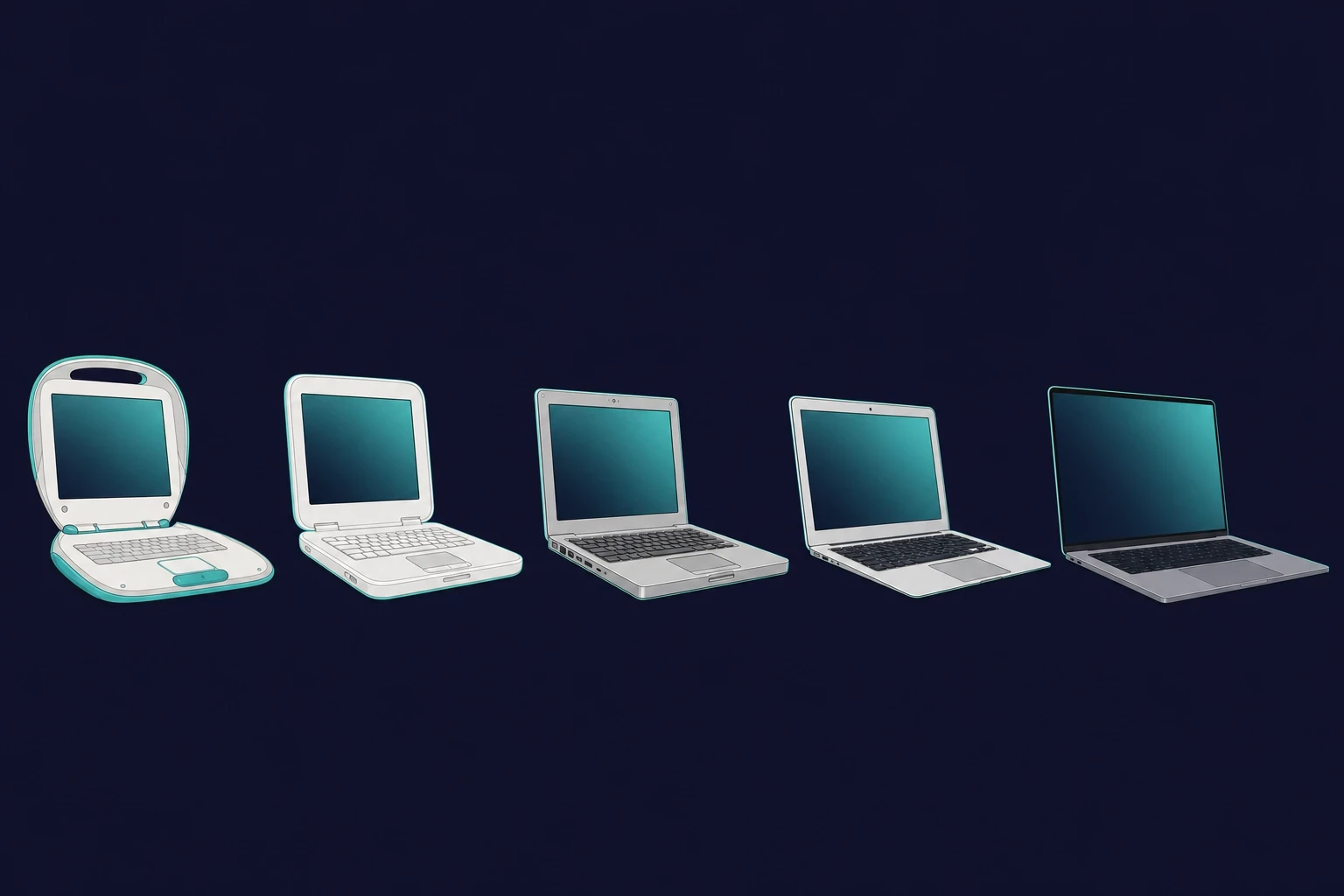
En esta página
- ›PowerBook 100 (1991)
- ›Modelos de MacBook por año (tabla cronológica completa)
- ›PowerBook 140 y 170 (1991)
- ›PowerBook Duo Series, 1992 a 1997
- ›PowerBook Serie 500 (1994)
- ›PowerBook G3 (1997-2001)
- ›PowerBook G4 (2001-2006)
- ›iBook G3 (1999-2003)
- ›iBook G4 (2003-2006)
- ›Primer MacBook Pro
- ›MacBook 2006
- ›MacBook Air
- ›MacBook (2008)
- ›MacBook Pro (pantalla Retina)
- ›MacBook (2015-2019)
- ›MacBook Pro (2016)
- ›MacBook Pro (2017-2019)
- ›MacBook Pro de 16 pulgadas (2019)
- ›MacBook Pro M1 (2020)
- ›MacBook Air M1 (2020)
- ›MacBook Pro M1- 14, 16 pulgadas- 2021
- ›MacBook Air M2 (2022)
- ›MacBook Pro de 13 pulgadas M2 (2022)
- ›Modelos MacBook Pro M2 (2023) de 14 y 16 pulgadas
- ›MacBook Air de 15 pulgadas (2023)
- ›MacBook Pro de 14 y 16 pulgadas M3 (2023)
- ›Apple Silicon toma impulso: M3 Air, M4 y M5 (2024-2025)
- ›Lista de generaciones de MacBook: de PowerPC a Apple Silicon
- ›Historia de macOS: El software detrás de las pantallas
- ›Preguntas frecuentes sobre la historia del MacBook
Cuando Steve Jobs presentó el primer MacBook Air sacándolo de un simple sobre de papel manila en 2008, no fue solo un lanzamiento, sino también una declaración. La historia del MacBook es una larga sucesión de reinvenciones, en la que Apple no dejó de combinar diseño e ingeniería para crear algo que se sentía como más que un ordenador.
De los voluminosos PowerBook de los primeros años a los finos Pro de la serie M de hoy, cada MacBook se ha reinventado una y otra vez. Esta guía recorre los modelos año a año para que veas cómo cambiaron los diseños, las funciones y los chips de Apple con el tiempo.
La versión corta
- El primer portátil de Apple fue el PowerBook 100, lanzado en 1991.
- El primer modelo llamado realmente “MacBook” salió en 2006, el mismo año en que Apple pasó a los chips Intel.
- Hay tres eras de chips: PowerPC (1991-2005), Intel (2006-2020) y Apple Silicon (de 2020 hasta hoy).
- Los modelos actuales son el MacBook Pro M5 (octubre de 2025) y el MacBook Air M4 (marzo de 2025).
PowerBook 100 (1991)

Antes del PowerBook 100, los ordenadores portátiles eran voluminosos y difíciles de transportar. Este modelo lo cambió con un diseño pequeño y ligero que hizo posible la informática portátil de verdad.
- Diseñado junto con Sony, era pequeño y ligero para su época
- El primer portátil de Apple con trackball, el antecesor del trackpad actual
- Un procesador Motorola 68000 que se encargaba de las tareas cotidianas
El PowerBook 100 fue un punto de inflexión para los portátiles de Apple. Marcó su primer paso en la informática portátil.
Modelos de MacBook por año (tabla cronológica completa)
Esta es la cronología completa del MacBook de un vistazo, del PowerBook 100 de 1991 al MacBook Pro M5 de 2025. La tabla relaciona cada línea de modelos con su año y su chip característico, para que puedas ir directamente a la generación que te interesa.
| Modelo | Año | Era del chip | Primicia destacada |
|---|---|---|---|
| PowerBook 100 | 1991 | Motorola 68000 | Primer portátil de Apple |
| PowerBook G3 “Wall Street” | 1997 | PowerPC G3 | Primero en ejecutar Mac OS X |
| Primer MacBook Pro | 2006 | Intel Core | Primer MacBook con Intel (feb. de 2006) |
| MacBook (policarbonato) | 2006 | Intel Core Duo | Primer modelo llamado “MacBook” (mayo de 2006) |
| MacBook Air | 2008 | Intel | El portátil más fino de su época |
| MacBook Pro (Retina) | 2012 | Intel | Primera pantalla Retina |
| MacBook (12 pulgadas) | 2015 | Intel Core M | Teclado de mariposa, solo USB-C |
| MacBook Pro M1 | 2020 | Apple M1 | El salto a Apple Silicon |
| MacBook Pro M1 Pro/Max | 2021 | Apple M1 Pro/Max | XDR Mini-LED, vuelven los puertos |
| MacBook Pro M3 | 2023 | Apple M3 | Acabado negro espacial |
| MacBook Air M4 | 2025 | Apple M4 | Desde $999, color azul cielo |
| MacBook Pro M5 | 2025 | Apple M5 | Buque insignia actual ($1,599) |
PowerBook 140 y 170 (1991)

El 140 y el 170 se lanzaron junto al PowerBook 100, pensados para profesionales que querían más rendimiento. El 170 fue el primer portátil de Apple con pantalla de matriz activa, que ofrecía una imagen más nítida.
- Procesadores más rápidos pensados para usuarios profesionales
- Los primeros portátiles de Apple con reposamuñecas para mayor comodidad
- Más pesados que el PowerBook 100, pero auténticas mulas de carga en su época
PowerBook Duo Series, 1992 a 1997

Este 2 en 1 convertía un portátil ultrafino en un ordenador de sobremesa mediante una base de conexión, una idea muy adelantada a su tiempo.
- El PowerBook más ligero de Apple, ideal para quienes viajaban con frecuencia
- Sin puertos; había que conectarlo a la base para usarlo a fondo
- Un diseño minimalista que anticipaba el MacBook Air
- La base de conexión nunca triunfó, pero señaló el camino que seguiría Apple
PowerBook Serie 500 (1994)

La serie PowerBook 500 introdujo uno de los mayores cambios de la historia de los portátiles: el trackpad.
- El primer portátil con trackpad, que prescinde del pesado trackball
- Altavoces estéreo integrados, algo raro en un portátil por entonces
- Modo de reposo de la batería para reanudar la actividad al instante
- La base de los trackpads de los MacBook modernos
PowerBook G3 (1997-2001)

“Wall Street” era el nombre del PowerBook G3, una auténtica potencia capaz de superar a muchos ordenadores de sobremesa de su época.
- Procesador PowerPC G3, el chip de portátil más rápido de su tiempo, en una elegante carcasa negra
- El primer portátil de Apple totalmente compatible con Mac OS X
- Abrió la puerta a los MacBook de alto rendimiento
PowerBook G4 (2001-2006)

El PowerBook G4 trajo el aspecto de aluminio que aún define a los MacBook de hoy.
- Cuerpos de aluminio y titanio resistentes y elegantes
- Pantallas de alta resolución en formatos panorámicos, ideales para el trabajo creativo
- El último PowerBook antes de que Apple pasara a los Mac con Intel
- El predecesor directo del MacBook Pro
iBook G3 (1999-2003)

El iBook G3 estaba pensado para estudiantes y usuarios ocasionales, y era divertido de usar.
- Formas brillantes de mandarina, arándano, uva y muchas más.
- El primero con Wi-Fi inalámbrico integrado
- Lo bastante resistente para aguantar caídas mejor que la mayoría de los portátiles
- El Mac que hizo de Apple una marca atractiva para los estudiantes que compraban su primer portátil
iBook G4 (2003-2006)

El iBook G4 transformó el G3 en algo más elegante y maduro.
- La carcasa de plástico era blanca y anticipaba el futuro MacBook
- Un nuevo procesador PowerPC G4, mucho más rápido que el de los modelos anteriores
- Optimizado para Mac OS X, de modo que el software funcionaba con fluidez en el hardware
- Una versión más barata del PowerBook que hizo más accesibles los portátiles Mac
Primer MacBook Pro

Apple lanzó el primer MacBook Pro en febrero de 2006, un gran salto adelante envuelto en aluminio. Con unos 2,5 kg y 2,5 cm de grosor, trajo novedades como el teclado retroiluminado y el conector MagSafe, que se soltaba de forma segura si alguien tropezaba con el cable.
- El portátil más rápido de su lanzamiento, con chips Intel cuatro veces más rápidos que el PowerBook G4
- Una pantalla luminosa, un trackpad amplio y un sensor de movimiento que aparcaba el disco duro en caso de caída
- Pronto llegó una versión de 17 pulgadas para usuarios avanzados que querían más píxeles
MacBook 2006

Más tarde, en 2006, Apple renovó su gama de consumo con el MacBook de policarbonato, que sustituyó al iBook y al PowerBook de 12 pulgadas. Fue menos una actualización que un nuevo comienzo.
- Diseño más fino con una brillante pantalla de 13 pulgadas
- Chips Intel Core Duo, 5 veces más rápidos que el iBook
- Cámara iSight integrada para videollamadas
- Protección contra caídas y MagSafe, prestados del MacBook Pro
- Disponible en blanco y negro, que se convirtió en objeto de culto
- Apple lo llamó “el portátil de consumo más avanzado del mundo”, y para muchos fue el primer Mac que se sentía realmente personal
MacBook Air

En 2008, Steve Jobs presentó el MacBook Air sacándolo de un sobre. Era el portátil más fino del mundo en aquel momento. Apple eliminó la unidad óptica SuperDrive y añadió un trackpad multitáctil con gestos.
Su diseño fino y ligero convirtió al Air en uno de los favoritos de los desarrolladores, sobre todo de quienes buscaban formas de desarrollar aplicaciones iOS sin Mac con configuraciones alojadas en la nube.
- Pantalla LED de 13 pulgadas con teclado retroiluminado de tamaño completo
- Cámara iSight integrada para videollamadas
- Debuta un modelo de 11,6 pulgadas para plantar cara a netbooks y ultrabooks
MacBook (2008)

Apple transformó el MacBook de policarbonato en una robusta carcasa unibody de aluminio. Steve Jobs lo llamó el ordenador más ecológico que Apple había fabricado, ya que cumplía los estándares medioambientales más exigentes: Energy Star 4.0, EPEAT Gold y RoHS.
- Todo ello sin productos químicos tóxicos (como cables sin PVC, pantallas LED sin mercurio y vidrio sin arsénico).
- Gráficos de alto rendimiento para portátiles en un paquete básico
MacBook Pro (pantalla Retina)

Apple llevó la pantalla Retina al MacBook Pro, la pantalla de portátil con mayor resolución de su época. Tenía más de 5 millones de píxeles, más que un televisor HD.
- Más ligero y casi tan fino como un MacBook Air
- No tiene SuperDrive óptica, sino que utiliza almacenamiento flash de estado sólido.
- Diseño minimalista
- Primer (y último) MacBook Pro con puerto HDMI
- Puerto de alimentación MagSafe 2 más delgado y altavoces mejorados
MacBook (2015-2019)

Apple resucitó el MacBook como su portátil más fino y ligero, con sólo 1,2 kilos y 13,1 mm de grosor.
- Pesa sólo 2 libras y tiene 13,1 mm de grosor, superando al MacBook Air
- Ligero y compacto, con pantalla Retina de 12 pulgadas y teclado mariposa con trackpad Force Touch.
- Liquidación de todos los puertos; sólo USB-C/Thunderbolt 3 sustituyó a MagSafe y USB-A
- Se refrigera solo y funciona en silencio
- Se descataloga en julio de 2019 para racionalizar la gama de MacBook de Apple
Es también la época del teclado de mariposa, que se recuerda con menos cariño. Con solo unos 0,7 mm de recorrido de tecla, se atascaba fácilmente cuando entraba polvo o migas, y se convirtió en el gran punto débil de estos modelos. Apple acabó lanzando un programa de reparación ampliado para cubrir los fallos.
MacBook Pro (2016)

Apple presentó el MacBook Pro de 2016 en diciembre, más fino y ligero que antes. La versión sin Touch Bar llegó incluso a sustituir al Air. Los modelos con Touch Bar, de 13 y 15 pulgadas, cambiaron las teclas de función por una pequeña franja táctil.
- Sensor Touch ID para un inicio de sesión mejor y más seguro
- Más conectividad con puertos Thunderbolt 3/USB-C
- Trackpad más grande y teclado mariposa mejorado
- Pantalla más brillante y ancha como la del iPhone 7
- Velocidad SSD y calidad de sonido mejoradas
- El color gris espacial llega a la colección MacBook Pro
- Apple bate un nuevo récord de ventas
MacBook Pro (2017-2019)

Chips más rápidos y mejores teclados han mejorado el nuevo MacBook Pro.
- Procesadores opcionales de 8 núcleos y chips Intel Coffee Lake (15 pulgadas)
- Hasta 32 GB de RAM para los modelos de gama alta
- Rediseño del teclado mariposa para maximizar la fiabilidad
- Modelo básico de 13 pulgadas con Touch Bar por debajo del radar
MacBook Pro de 16 pulgadas (2019)

El MacBook Pro de 16 pulgadas tenía la pantalla Retina más grande que Apple había puesto nunca en un MacBook.
- Resolución de 3072 x 1920 y densidad de píxeles de 226 ppp
- El nuevo teclado sustituye al tipo mariposa
- Hasta 64 GB de RAM y 8 TB de almacenamiento SSD
- Procesadores Intel de 9.ª generación con mejor gestión térmica
- Un sistema de sonido de 6 altavoces con un conjunto de micrófonos mejorado
MacBook Pro M1 (2020)

El chip M1 dio al MacBook Pro su mejor rendimiento y la mayor autonomía hasta entonces.
Con el paso a Apple Silicon, muchos desarrolladores buscaron nuevas formas de probar aplicaciones iOS en Windows en remoto antes de pasarse del todo a los Mac con M1.
- Una CPU de 8 núcleos para un procesamiento rápido
- Dos puertos Thunderbolt para conectividad
- Teclado Magic Keyboard con nuevo diseño
- Peso ligero de 1,5 kg para mayor portabilidad
MacBook Air M1 (2020)

El MacBook Air M1 era más rápido que antes y, lo mejor de todo, tenía un diseño silencioso sin ventilador.
- Chip M1 de 8 núcleos con una GPU de 7 u 8 núcleos
- Gráficos cinco veces mejores con un procesamiento 3,5 veces más rápido
- Una unidad SSD ultrarrápida, el doble que la de los modelos anteriores
- Alrededor de 18 horas de duración de la batería
- Magic Keyboard y tres colores: Plata, Gris espacial y Oro
MacBook Pro M1- 14, 16 pulgadas- 2021

Los nuevos MacBook Pro de Apple funcionan con sus últimos M1 Pro y M1 Max, que suponen un gran aumento de rendimiento.
- CPU 70% más rápida con 3× de ancho de banda de memoria para un aumento significativo de la velocidad.
- GPU de 32 núcleos que multiplica por 4 el rendimiento gráfico
- Pantalla mini-LED XDR con teclas de función
- Tres puertos Thunderbolt 4, una ranura SDXC y HDMI para una conectividad versátil.
- Cámara HD 1080p integrada con un sistema de seis altavoces
MacBook Air M2 (2022)

El MacBook Air M2 estrenó un diseño nuevo y el chip M2, más reciente, de Apple.
- Incorpora el nuevo procesador M2 para mejorar el rendimiento
- Pantalla Liquid Retina de 13,6 pulgadas más grande
- Ultrafino (11,3 mm) y ultraligero (2,7 libras)
- Disponible en plata, gris espacial, medianoche y Starlight
- Cámara HD 1080p, cuatro altavoces y teclas de función físicas
- Admite carga rápida con un adaptador USB-C de 67 W.
MacBook Pro de 13 pulgadas M2 (2022)

El MacBook Pro de 13 pulgadas mantuvo su diseño clásico, pero ganó un buen impulso con el chip M2.
- Chip M2 con CPU de 8 núcleos y GPU de 10 núcleos
- Admite hasta 24 GB de memoria unificada y 2 TB de almacenamiento
- Mantiene la Touch Bar, el único MacBook que lo hace
- Cámara de 720p, altavoces estéreo y un peso de un kilo
- Disponible en plata y gris espacial
Modelos MacBook Pro M2 (2023) de 14 y 16 pulgadas

Los chips M2 Pro y M2 Max supusieron una gran mejora de potencia para los MacBook Pro de 2023.
- Autonomía de 22 horas
- Mejora la velocidad de conexión Wi-Fi 6E
- HDMI actualizado para salida 8K
- Ofrece hasta 96 GB de memoria unificada con M2 Max
- Pantalla Liquid Retina XDR, cámara FaceTime HD 1080p
- Seis micrófonos de altavoz con calidad de estudio
La potencia del M2 Max lo hace ideal para cargas de trabajo como el despliegue de modelos de IA - muchos profesionales ahora ejecutar grandes modelos lingüísticos en un Mac sin necesidad de GPU externas.
MacBook Air de 15 pulgadas (2023)

El MacBook Air de 15,3 pulgadas de Apple es 25% más grande que el de 13 pulgadas.
- 11,5 mm de grosor, 3,3 libras de peso
- Chip M2 con CPU de 8 núcleos, GPU de 10 núcleos y motor neuronal de 16 núcleos.
- Pantalla Liquid Retina con 500 nits de brillo
- Admite hasta 24 GB de RAM unificada y ofrece 18 horas de duración de la batería.
- Diseño artístico con un sistema de audio espacial de ocho altavoces para un funcionamiento silencioso
- Cámara FaceTime HD 1080p (sólo en EE.UU.) y carga MagSafe
MacBook Pro de 14 y 16 pulgadas M3 (2023)

A finales de 2023, Apple actualizó el MacBook Pro con los chips M3, M3 Pro y M3 Max para ganar velocidad y eficiencia.
- Modelo de 14 pulgadas con chip M3, CPU de 8 núcleos, GPU de 10 núcleos y motor neuronal de 16 núcleos.
- Modelos de 16 pulgadas con M3 Pro o M3 Max, hasta 128 GB de RAM y una unidad SSD de 8 TB
- Pantalla Liquid Retina XDR con 1000 nits de brillo sostenido
- Nuevo color negro espacial con acabado antihuellas
Apple Silicon toma impulso: M3 Air, M4 y M5 (2024-2025)
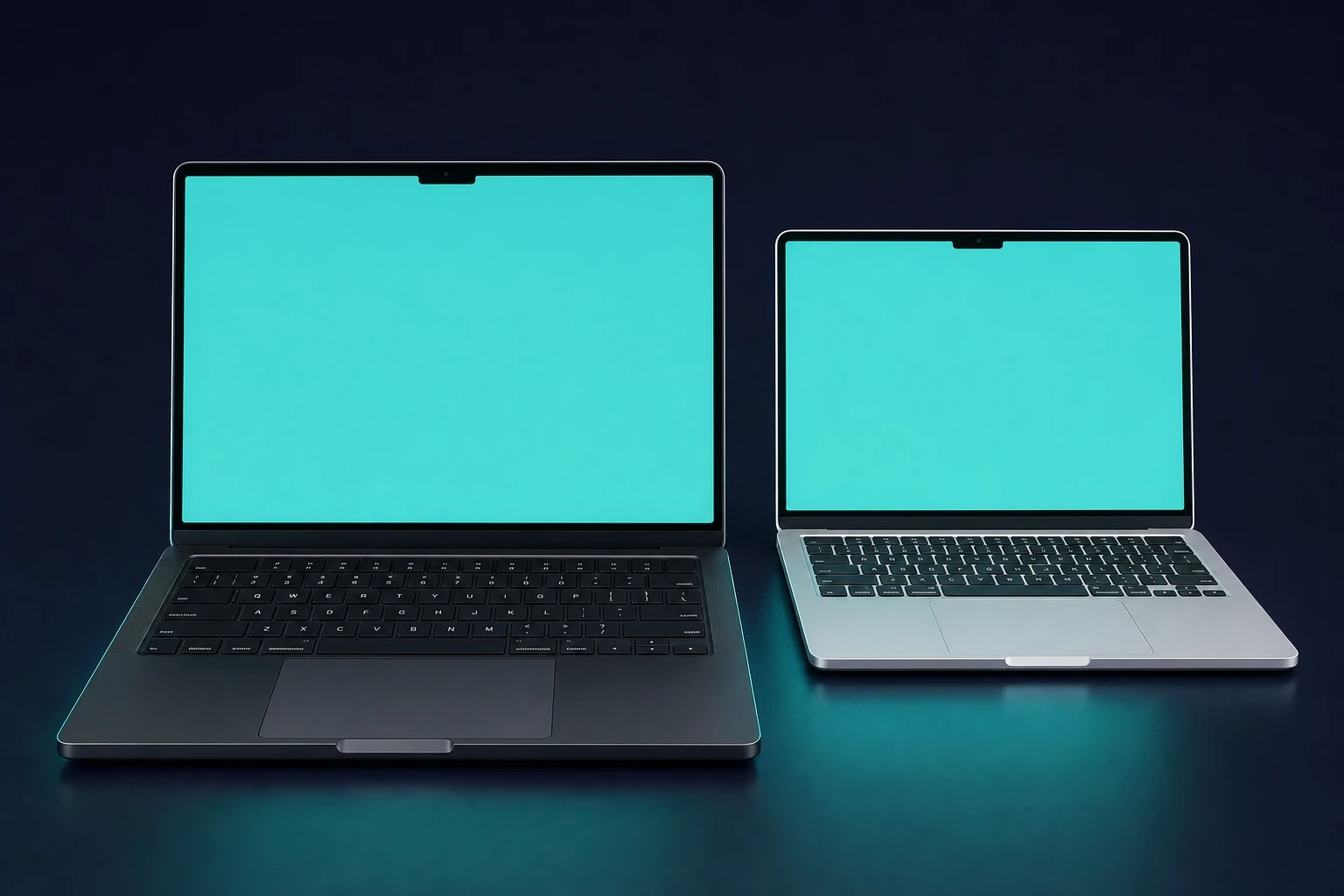
La etapa más reciente de la evolución del MacBook avanza deprisa. Tras el M3 de finales de 2023, Apple mantuvo el ritmo: el MacBook Air M3 en marzo de 2024, el MacBook Pro M4 en octubre de 2024, el MacBook Air M4 en marzo de 2025 y el MacBook Pro M5 en octubre de 2025. Esto es lo que cambió cada uno.
El MacBook Air M3 llegó el 4 de marzo de 2024, en tamaños de 13 y 15 pulgadas. Llevó el chip M3 a la gama Air, más ligera, y cubrió el hueco entre el Air M2 de 2022 y la era M4.
Después llegó el MacBook Pro M4, el 30 de octubre de 2024, en tamaños de 14 y 16 pulgadas y con M4, M4 Pro o M4 Max a elegir. El modelo base de 14 pulgadas parte ahora de 16GB de RAM, algo importante si estás valorando si un MacBook merece la pena para trabajos más exigentes.
El MacBook Air M4 (12 de marzo de 2025) parte de $999, añade una cámara Center Stage de 12 MP y un nuevo acabado azul cielo, y eleva el ancho de banda de memoria a 120 GB/s, frente a los 100 GB/s del M3. Para una carga de trabajo como la de un MacBook para ciencia de datos, ese ancho de banda extra se nota en las pruebas reales.
El buque insignia actual es el MacBook Pro M5, lanzado el 22 de octubre de 2025, con reservas la semana anterior. El modelo de 14 pulgadas parte de $1,599 con CPU de 10 núcleos, GPU de 10 núcleos y Neural Engine de 16 núcleos. En el lanzamiento, el de 16 pulgadas se quedó con el M4 Pro y el M4 Max en lugar de pasar directamente al M5.
Lista de generaciones de MacBook: de PowerPC a Apple Silicon
Si ponemos toda la gama en fila, vemos un patrón claro: cada era de chips hizo el MacBook más rápido, mientras Apple seguía buscando diseños más finos y ligeros.
- La era PowerPC (1991-2005): PowerBooks e iBooks con chips Motorola/IBM
- Transición Intel (2006-2020): CPU más rápidas, pero con problemas térmicos
- Apple Silicon (de 2020 hasta hoy): la serie M, que ya abarca del M1 al M5, acalló a los primeros escépticos y cambió lo que la gente esperaba de un portátil funcionando con batería
Historia de macOS: El software detrás de las pantallas
Cada MacBook depende de su sistema operativo. ¿Te acuerdas de Mac OS 9 (1999)? Incluía Sherlock para buscar archivos. Después llegó OS X Tiger (2005) con Spotlight y los widgets de Dashboard. macOS Sonoma (2023) permitió convertir sitios web en apps y añadió un modo de juego para jugar con más fluidez.
Apple ha lanzado dos versiones más desde entonces. macOS Sequoia llegó el 16 de septiembre de 2024 y macOS Tahoe le siguió el 15 de septiembre de 2025. Tahoe fue el primer macOS en abandonar por completo el soporte para Intel y el que introdujo la interfaz Liquid Glass. La versión más reciente es macOS Tahoe 26.5, publicada el 11 de mayo de 2026.
Preguntas frecuentes sobre la historia del MacBook
Respuestas rápidas a las preguntas más frecuentes sobre la historia del MacBook.
¿Cuándo salió el primer portátil de Apple?
El PowerBook 100, el primer portátil de Apple, salió en 1991. Llevó la informática portátil a la gama Mac con un trackball y un procesador Motorola 68000, y estableció el modelo sobre el que se han construido todos los portátiles de Apple desde entonces.
¿Cuándo salió el primer MacBook?
El primer producto llamado realmente “MacBook” llegó en mayo de 2006: el modelo de consumo de policarbonato que sustituyó al iBook. El primer MacBook Pro había salido unos meses antes, en febrero de 2006, como el primer portátil de Apple con Intel.
¿Cuál es el modelo de MacBook más reciente?
En 2025, el buque insignia es el MacBook Pro M5, lanzado el 22 de octubre de 2025, desde $1,599. El Air actual es el MacBook Air M4 de marzo de 2025, que parte de $999.
¿Cuántas generaciones de MacBook hay?
La división más clara es en tres eras de chips: PowerPC (1991-2005), Intel (2006-2020) y Apple Silicon, que va del M1 en 2020 al M5 en 2025. Dentro de la era Apple Silicon, el M1, M2, M3, M4 y M5 cuentan cada uno como una subgeneración, así que puedes agrupar la gama de una forma u otra según el nivel de detalle que quieras.
¿Cuál fue el peor teclado de MacBook?
La mayoría señala el teclado de mariposa de la época 2015-2019. Con solo unos 0,7 mm de recorrido de tecla, se atascaba cuando entraba suciedad bajo una tecla, y los fallos fueron tan frecuentes que Apple lanzó un programa de reparación ampliado.
¿Cuál fue el MacBook más fino?
El MacBook de 12 pulgadas de 2015 fue el más fino de su época, con 0,9 kg y 13,1 mm. El MacBook Air de 2008 marcó la referencia original de delgadez, y la historia del Mac mini sigue una trayectoria similar en el terreno de los ordenadores de sobremesa.