 ES
ES  EN
EN  PT
PT  TR
TR  FR
FR  AR
AR 
On this page
Debido a las restricciones de licencia de Apple, es difícil desarrollar una aplicación para iOS fuera del entorno MacOS.
Sin embargo, hay varias formas de Desarrollar aplicaciones iOS sin Mac para desarrolladores y empresas que no quieren invertir en la compra de un ordenador Apple.
En este artículo, describiremos cinco formas diferentes de desarrollar aplicaciones iOS en Windows, sus restricciones y sus ventajas.
In short:
- Yes, you can develop iOS apps on Windows.
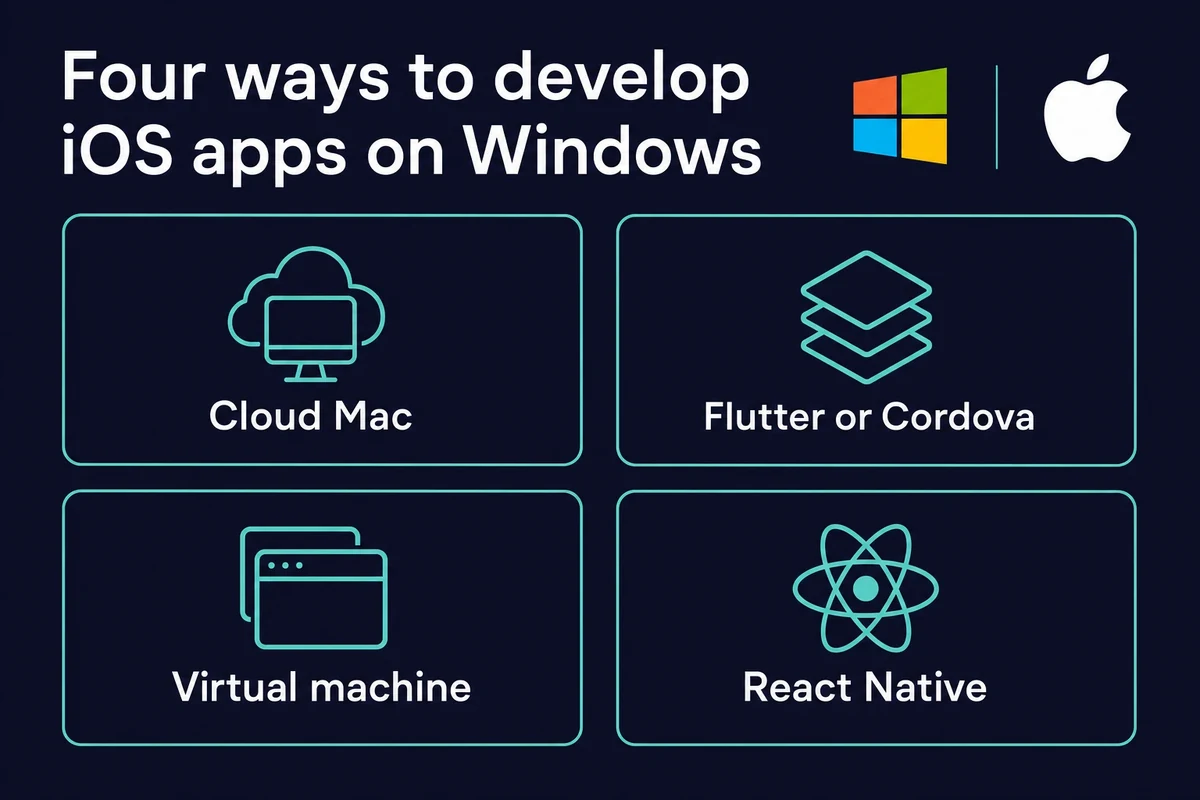
- Methods: a cloud Mac, Flutter or Cordova, a virtual machine, or React Native.
- The final build, code signing, and App Store submission still need a Mac running Xcode 26.
Las mejores formas de desarrollar una aplicación iOS en Windows
Para desarrollar una aplicación iOS en Windows, los programadores pueden utilizar varios métodos, como
- Alquilar un Mac en la nube
- Utilizar herramientas multiplataforma como Flutter y Cordova
- Crear una aplicación en una máquina virtual
- Trabajar en un entorno React-native
These same methods let you develop iPhone apps on Windows, since an iPhone app and an iOS app use the same Lenguaje de programación Swift and Xcode toolchain. So if you are wondering can you make iOS apps on Windows, the short answer is yes, with one Mac-only step at the end.
One thing to know up front: Xcode is built for macOS, and the current line is Xcode 26 (with the 26.2 SDK in 2026). Running older Xcode builds on Windows is unstable and not supported.
Newer tools have narrowed the gap a little. An open-source tool called xtool can build and sign Swift Package iOS apps from Windows, but it still needs Apple’s Xcode.xip and a Mac account for some signing.
Swift’s own Windows toolchain (via winget) covers command-line and server Swift, not native iOS builds. You can write on Windows, but shipping still needs a Mac.
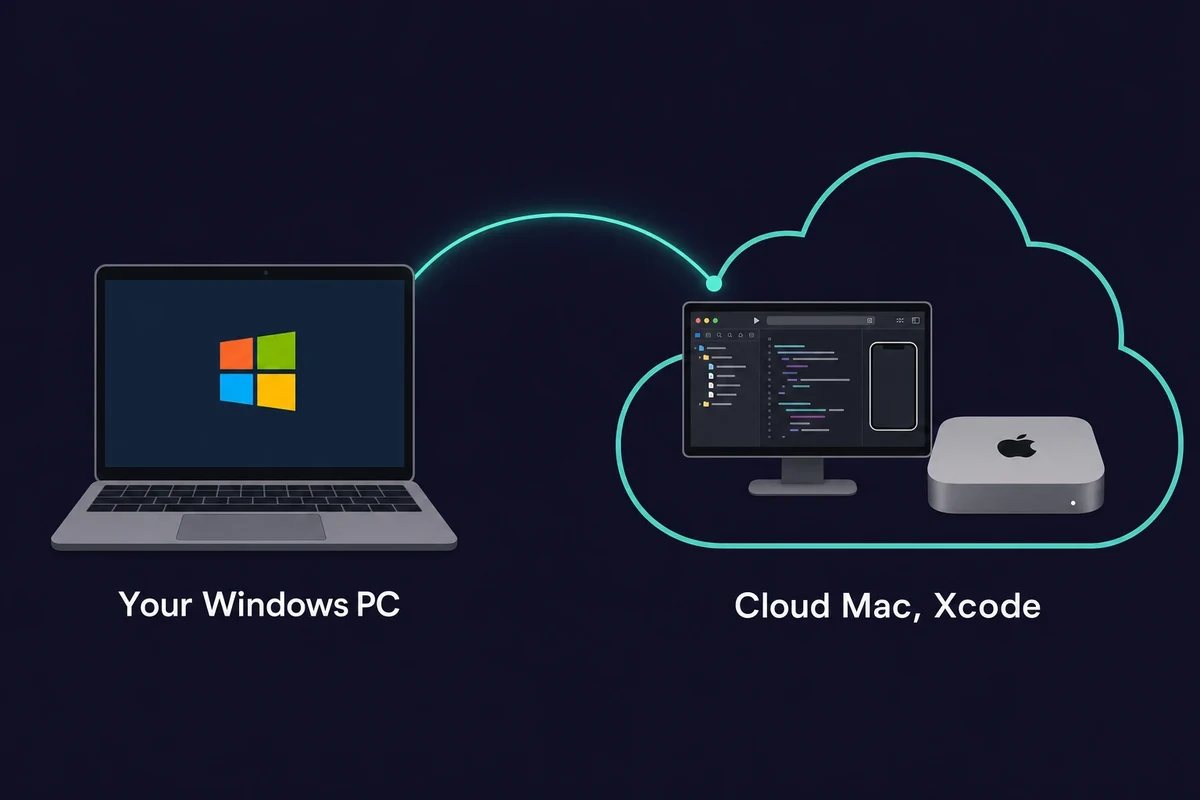
Alquilar un Mac en la nube
La primera y mejor opción es alquilar un Mac en la nube. De esta forma, usted puede acceder al entorno Mac sin comprar ningún hardware.
Remote services match real Macs in performance and are fit for tasks of any complexity. They are great for a DevOps application development project, where you have to quickly fix things online and debug running apps.
Si tienes que desarrollar apps complejas de IA, hacerte con un Mac en la nube es la mejor opción de todas las descritas en este artículo.
Los Mac en nube le permiten ejecutar modelos LLMTrabaja con grandes cantidades de datos o realiza otras tareas informáticas como si trabajaras en un Mac de verdad.
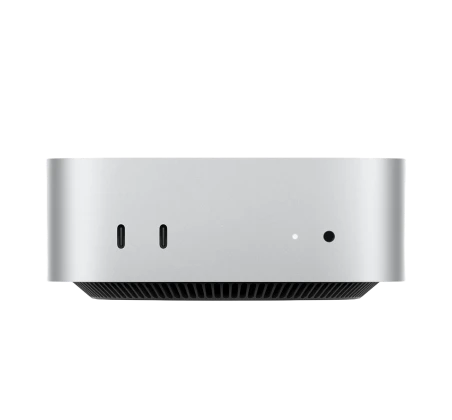
That is why rented cloud Macs have taken off: you get a full iOS environment in a few clicks, on a monthly plan rather than the price of a new Mac. Rentamac.io rents a dedicated Mac Mini M4 (16GB RAM, macOS Tahoe) with full admin access, so any iOS build tool runs as it would on a Mac on your desk.
Utilizar herramientas multiplataforma como Flutter y Cordova
Las herramientas de desarrollo móvil multiplataforma nos permiten codificar las aplicaciones en una plataforma y exportarlas a otra. En otras palabras, puedes desarrollar una aplicación para iOS en Windows o Linux o viceversa.
The most popular tools are Flutter and Cordova. Their real benefit is one codebase: Flutter uses a single Dart project and Cordova wraps a web app, and both ship that one project to iOS and Android, which cuts the separate-platform build work.
Flutter, de Google, permite crear aplicaciones atractivas para iOS y Android utilizando un único conjunto de código con Dart. Cordova ayuda colocando aplicaciones web en un paquete nativo, lo que simplifica su implantación en dispositivos móviles.
Yet, to deploy and test an app, you’ll need an Apple device or iOS emulators. While you’ll still need a Mac or emulator to test the final app, it’s possible to simular iOS en Windows para previsualizaciones tempranas y depuración de interfaces.
Construir una máquina virtual
Otra forma de desarrollar aplicaciones iOS en Windows es crearlas en una máquina virtual.
Una máquina virtual le permite crear un sistema operativo dentro de otro ya existente.
In other words, you can use a Windows computer to build a virtual copy of MacOS or Linux. With tools like VMware or VirtualBox, you can easily access one OS. A macOS virtual machine for Xcode usually wants 4 to 8 GB of RAM, an Intel i5 or i7 class CPU, and at least 10 GB of free disk space.
Dado que este método simplifica el cambio entre sistemas operativos, suele utilizarse para crear y probar aplicaciones híbridas.
Sin embargo, al utilizar este método, debe tener en cuenta varias cosas. En primer lugar, el método no es estable, por lo que puede perder datos durante las actualizaciones del sistema operativo.
Una máquina virtual es mucho más lenta que un Mac real, y experimentarás problemas, especialmente si utilizas un simulador de SO. Será difícil detectar o solucionar problemas con una aplicación en ejecución. Lo mismo ocurre con las peculiaridades de Xcode: tu simulador puede ir muy lento.
Since this method is legally grey, as it circumvents Apple’s legal constraints, the Apple App Store may flag some of your submissions. A Hackintosh, running macOS on non-Apple hardware, sits in the same grey area and is best avoided.
Trabajar en un entorno React-native
React Native es otra forma de desarrollar aplicaciones nativas o híbridas para iOS y Android. Es una herramienta de código abierto con una potente comunidad de soporte.
Reaccione le permite utilizar el mismo código para distintas plataformas, which is great for cross-platform mobile development and greatly simplifies the work. However, to properly probar aplicaciones iOS en Windowsnecesitarás un emulador o un entorno Mac basado en la nube.
La mejor forma de desarrollar aplicaciones iOS en Windows
Since Xcode is still the best tool for developing iOS apps, every other path to iOS app development on Windows comes with trade-offs, like:
- Problemas de compatibilidadLas herramientas de desarrollo de aplicaciones iOS no son compatibles con Windows, por lo que el proceso de desarrollo de aplicaciones puede ser más costoso y no tan fluido como en el entorno nativo.
- Problemas de estabilidad: Con diferentes alternativas de macOS, puede haber algunos problemas de estabilidad en el rendimiento de la aplicación.
- Limitaciones de la cadena de herramientasEl desarrollo de apps para iOS depende de las herramientas y librerías creadas específicamente para MacOS. Estas son esenciales para depurar y optimizar el rendimiento de las apps, y solo están disponibles en MacOS.
Puede que estas limitaciones no sean graves, pero dificultan la creación de aplicaciones de alto rendimiento con un espectro completo de funciones.
One rule applies no matter which method you pick. The final iOS build, the code signing, and the App Store submission all require macOS and Xcode. Apple now requires every App Store Connect upload to be built with the iOS 26 SDK (Xcode 26 or later), a rule it enforces as of April 28, 2026.
A free cloud build runner is no real shortcut: a GitHub Actions free plan gives only about 20 minutes of macOS build time a month. A rented cloud Mac is the steady way to meet that gate.
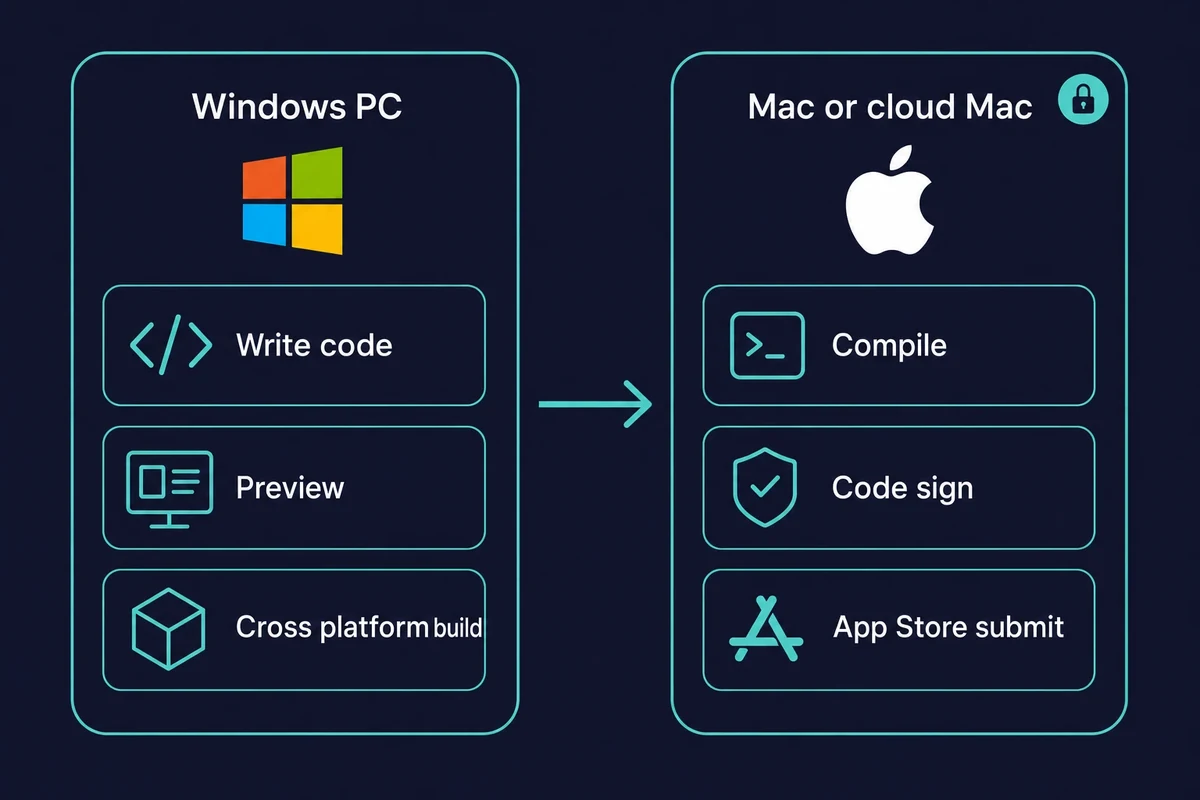
Yet, you can still develop an iOS app on Windows without limitations if you rent a Mac in the cloud. Honestly, this is the route I’d pick first. You will always have access to the latest Mac device and can use it only when needed. You also have other benefits at hand.
Ventajas de alquilar un Mac
Rented cloud Mac services are a perfect option if you need to develop an iOS app on Windows for a range of reasons:
- Actualizaciones flexibles: When you need the latest version of the device, you can transition effortlessly, often at no extra charge. That beats buying a Mac, which you can’t swap out instantly
- Costes bajos: For a monthly plan you get a dedicated Mac with full administrative rights, the quality of a real Mac at a fraction of the cost of buying one
- Escalabilidad: Si tu equipo crece y necesitas más Macs, los consigues en varios clics
- Sin mantenimiento: With online renting services, you don’t handle device repairs when something goes wrong. You get timely support or a substitution.
So, when you rent a Mac, you get high-quality Mac hardware on your own computer, without being tied to upfront costs or outdated machines. Cloud Mac rental services exist for exactly this, and Rentamac.io is one of them.
Therefore, renting a Mac online is your best option for building an iOS app on Windows.
Common questions about developing iOS apps on Windows
Can you develop iOS apps on Windows?
Yes, you can develop iOS apps on Windows, but you cannot finish the job there. You write and test on Windows using cross-platform frameworks, then the final build, code signing, and App Store submission happen on a Mac running Xcode. A rented cloud Mac handles that last step.
Do you need a Mac to develop iPhone apps?
You can write and preview iPhone apps on Windows, but a Mac is required for the final build and App Store submission. An iPhone app and an iOS app are built the same way, so the answer to can you develop iPhone apps on Windows is yes for the code, with a Mac at the end.
Can you publish an iOS app to the App Store without a Mac?
No. App Store Connect uploads must be built with Xcode 26 (the iOS 26 SDK) or later on macOS, a requirement Apple enforces as of April 28, 2026. There is no supported way around it, so a rented cloud Mac is the simplest fix.
Can I build an iOS app on Windows using React Native or Flutter?
Yes for the code. React Native and Flutter let you write one codebase on Windows, so you can build iOS apps on Windows up to the final compile. That last step, the compile, signing, and submission, still needs a Mac.
Will Xcode ever come to Windows?
There is no native Windows version of Xcode. Some workarounds run it inside a macOS virtual machine, with real trade-offs in speed and stability, and others use Xcode on Windows through a remote Mac. The practical route is a remote or rented Mac.